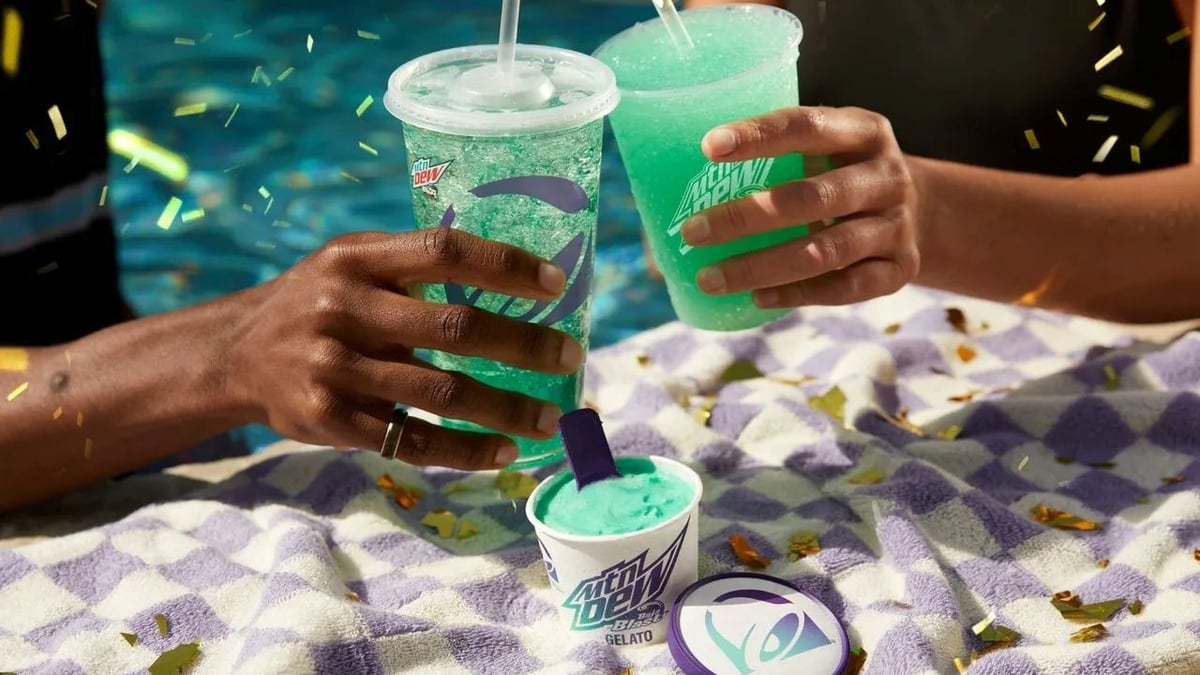
Taco Bell and PepsiCo have locked in their partnership through 2036, extending one of the quick-service restaurant industry's most productive corporate marriages. The agreement keeps the soft drink giant as the primary beverage supplier for Taco Bell's roughly 8,000 U.S. locations while securing exclusive rights to co-develop food and beverage products.
This partnership has produced some of the most successful menu innovations in fast-food history. Mountain Dew Baja Blast, introduced in 2004, became a permanent menu fixture after initially launching as a limited-time offering. The tropical lime flavor generated cult-like consumer devotion, transforming what began as a test into one of Mountain Dew's top variants. Doritos Locos Tacos arrived in 2012, bringing the chip brand directly into the taco shell itself. That product alone drove measurable traffic increases to Taco Bell locations and expanded the chain's daypart reach beyond lunch and dinner.
The extension signals confidence from both parties in their ability to identify consumer trends and execute them quickly. PepsiCo brings distribution scale and innovation labs. Taco Bell contributes speed-to-market capabilities and insights into what younger, more adventurous consumers want. Neither company releases exact sales figures on co-branded products, but industry analysts attribute significant revenue growth at Taco Bell to these collaborations.
The timing matters. The QSR sector faces intensifying competition from ghost kitchens, delivery-focused concepts, and regional chains gaining national reach. Established players like Taco Bell need differentiation beyond price and speed. Proprietary products with cultural relevance do that work. A new Doritos or Mountain Dew collaboration generates social media momentum and justifies menu boards at a time when consumers scroll through dozens of ordering options on their phones.
PepsiCo's ownership of both beverages and snacks (Doritos, Lay's, Cheetos, Tropicana, Gatorade) gives it unique leverage. Few suppliers can offer what PepsiCo can. The company controls the entire ecosystem of what consumers crave in a quick-service environment. That vertical integration means faster iteration and fewer negotiating parties when launching innovations.
The 2036 timeline extends through what both companies expect to be significant demographic shifts. Gen Z and Gen Alpha will dominate restaurant spending by then. These cohorts grew up with limited-time offerings, viral menu drops, and ingredient transparency as baseline expectations. They treat food choices as identity statements. A Baja Blast or Doritos Locos Tacos signals belonging to a cultural moment. That won't change by 2036.
For Taco Bell specifically, this partnership protects against beverage margin pressure. When chains source beverages independently, they sacrifice markup. Exclusive agreements with major suppliers often include volume discounts that improve unit economics. It also prevents Taco Bell from becoming a vehicle for competing brands like Coca-Cola products, which could happen if the relationship dissolved.
The partnership extension suggests neither company sees disruption on the horizon that would break their model. Taco Bell remains confident in its ability to operate profitably. PepsiCo trusts the chain will continue growing U.S. presence. For consumers, it means more collaborations combining snacks, beverages, and quick-service preparation into products specifically engineered for their tastes. Whether that innovation sustains through 2036 depends on whether either partner can move faster than the next trending concept.