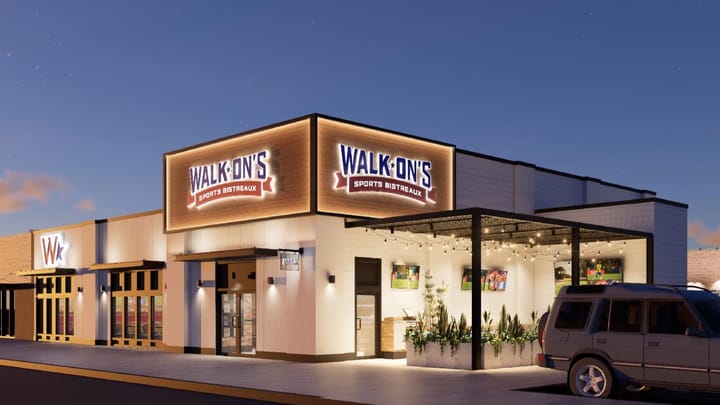
Walk-On's Bistreaux and Bar, the Louisiana-based sports bar empire built by NFL veteran Jack Lancia, is rolling out a smaller prototype concept that promises to reshape unit economics for franchisees struggling with overhead costs.
The chain's new scaled-down model cuts the footprint by approximately 40 percent compared to flagship locations, dropping from roughly 8,500 square feet to around 5,000 square feet. This pivot addresses a persistent challenge in sports bar franchising: ballooning real estate and labor costs that make traditional large-format venues increasingly difficult to operate profitably in smaller or secondary markets.
Walk-On's operates over 50 locations across the United States, with expansion plans that have relied heavily on larger urban and suburban footprints. The new prototype acknowledges market realities. A 5,000-square-foot space requires fewer staff members, consumes less utilities, and demands lower rent in markets where premium sports bar real estate commands premium pricing. The chain maintains the full Walk-On's experience, including its signature Cajun-inspired menu, full sports betting integration where legal, and the high-energy atmosphere that defines the brand.
This move reflects broader industry trends. Mid-size casual dining and bar operators have increasingly adopted "right-sizing" strategies over the past three years. Concepts like Applebee's and Buffalo Wild Wings have experimented with smaller prototypes to penetrate underserved markets and reduce capital requirements for new franchisees. Walk-On's decision accelerates this trend within the sports bar category.
For franchisees, the numbers matter considerably. A smaller prototype typically reduces initial capital investment by 30 to 40 percent. This lower barrier to entry attracts owner-operators with limited capital but proven operational experience. Walk-On's also positions itself ahead of potential economic headwinds that could constrain franchisee spending in 2024 and beyond.
The concept doesn't sacrifice revenue potential. A more efficient kitchen layout, smaller bar footprint, and optimized seating still generate substantial sales in the right locations. The chain has tested the prototype and refined the design based on operational feedback from existing franchisees.
Walk-On's founder Jack Lancia built the brand on high-touch customer service and premium sports viewing experiences. The smaller format maintains these core elements while eliminating redundancies that larger locations accumulate. Menu offerings remain consistent, ensuring brand recognition and operational consistency across units.
This prototype deployment signals confidence in franchisee recruitment. The sports bar category remains competitive, with established players like Hooters, Dave and Buster's, and regional chains all competing for leisure spending. A lower-cost entry point helps Walk-On's compete more effectively for prospective franchisees evaluating category options.
The chain anticipates rolling out multiple smaller prototypes within key markets in the coming months. Early adopters will likely emerge in secondary cities where walk-On's has brand awareness but limited presence. The strategy balances growth ambitions with financial prudence, a calculation increasingly essential in casual restaurant franchising.