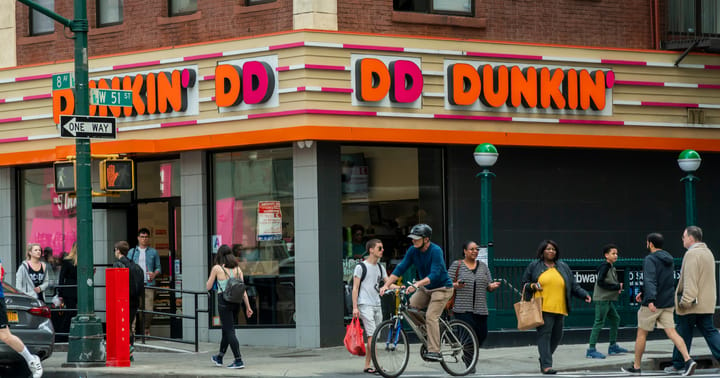
Walmart enters the restaurant delivery space with a strategic partnership that brings Dunkin' products directly to customers' homes alongside their grocery hauls. Starting soon, shoppers will order coffee, donuts, and other Dunkin' items through Walmart's delivery service, streamlining their shopping experience by combining quick-service restaurant fare with household essentials.
This move represents Walmart's calculated expansion beyond traditional grocery delivery. The retail behemoth has tested restaurant partnerships for months, and the Dunkin' collaboration signals confidence in bundling QSR offerings with supermarket staples. Customers ordering groceries for delivery will see Dunkin' menu items available at checkout, eliminating the need for separate food app transactions.
Dunkin' gains significant reach through Walmart's massive delivery infrastructure, which spans thousands of U.S. locations. The coffee chain, already ubiquitous with over 9,000 domestic locations, taps into Walmart's logistics advantage without managing its own delivery fleet. This partnership addresses a key friction point for consumers: most coffee and donut runs require separate ordering processes from grocery shopping.
The timing capitalizes on shifting consumer behavior. Post-pandemic delivery adoption remains sticky, with customers expecting multi-category fulfillment. Americans increasingly view delivery services not as novelties but as time-saving necessities. Combining a morning coffee run with grocery restocking appeals to harried shoppers juggling multiple errands.
Walmart's restaurant strategy differs sharply from rivals. Amazon has dabbled with restaurant delivery through its Prime service, while DoorDash and Uber Eats dominate standalone QSR delivery. Walmart's approach leverages its existing customer base and delivery network, converting grocery orders into larger baskets by adding beverage and snack categories. The strategy mirrors how convenience stores bundle coffee with other impulse purchases, except at scale.
Dunkin's participation reflects larger industry trends. Major QSRs increasingly partner with non-traditional platforms to reach delivery-dependent consumers. Starbucks has deals with Uber Eats and delivery services, but Dunkin' sees value in Walmart's grocery-first positioning. Customers buying milk and bread might impulse-order a half-dozen donuts or a coffee pack without downloading another app.
Operational challenges remain. Coordinating fresh product timing between Dunkin' kitchens and Walmart delivery windows requires precision. Donuts and coffee demand freshness; delays damage product quality and customer satisfaction. Walmart's existing cold-chain logistics handle frozen and refrigerated goods well, but hot beverage delivery presents new technical hurdles.
Pricing and margins tell another story. Walmart typically demands lower markups than restaurants prefer, creating potential friction. Dunkin' will need to accept lower per-unit margins, offsetting losses with volume from Walmart's customer reach. Neither party disclosed pricing or revenue splits.
Competitors watch closely. McDonald's, Taco Bell, and Chipotle must evaluate similar grocery-delivery partnerships. Kroger, Target, and other major retailers will likely pursue their own QSR alliances. The convenience layer this partnership creates could reshape how Americans access quick-service food, transforming grocery delivery into something closer to a general convenience platform.
This represents neither a revolutionary shift nor a minor footnote. It signals that delivery consolidation continues, with retailers leveraging logistics advantages to capture food spending previously fragmented across apps and platforms.