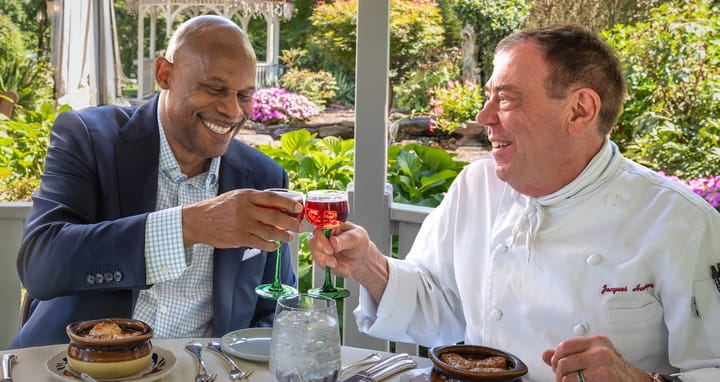
L'Auberge Chez Francois, the Washington, D.C. region's most storied French restaurant, has found a lifeline. Warren Thompson, a longtime patron of the Great Falls, Virginia establishment, has pledged financial support to secure the restaurant's future after 72 years of operation.
The move signals hope for one of America's most enduring fine dining institutions. L'Auberge Chez Francois opened in 1952 and became legendary for its classical French cuisine, intimate fireplace-lit dining rooms, and commitment to hospitality that defined destination dining for generations of East Coast diners. The restaurant earned a devoted following among diplomats, politicians, and food enthusiasts who traveled to the Virginia countryside specifically to experience its prix-fixe menus and exceptional wine program.
Thompson's involvement through his restaurant group suggests more than a sentimental rescue. Thompson Restaurants operates multiple establishments, and his pledge to support L'Auberge Chez Francois indicates a belief that the restaurant retains both business viability and cultural value worth preserving. The support comes at a time when independent fine dining restaurants face mounting pressures from labor costs, real estate expenses, and changing dining preferences that favor casual concepts over formal, multi-course service.
L'Auberge Chez Francois represents a particular vulnerability in American restaurant culture. Classical French fine dining requires significant expertise, infrastructure, and customer base maintenance. The restaurant's survival depends on preserving institutional knowledge among staff, maintaining costly kitchen operations, and sustaining relationships with patrons accustomed to its distinctive service style. Loss of such establishments reshapes regional food culture and removes touchstones for how fine dining functions.
The restaurant's Great Falls location, about 30 miles northwest of downtown D.C., has served as part of its identity. The setting transforms dining into an occasion, requiring commitment from guests to venture beyond urban cores. This worked beautifully during decades when fine dining dominated special-occasion spending. Recent decades have seen changing patterns, with younger diners favoring neighborhood spots and chef-driven casual restaurants over destination fine dining.
Thompson's pledge addresses succession and sustainability questions that plague independent restaurants. Family-operated establishments often struggle with generational transitions, and without clear ownership and investment plans, even beloved institutions can close suddenly. By bringing in Thompson's operational expertise and financial resources, L'Auberge Chez Francois gains infrastructure to navigate labor markets, adjust menus thoughtfully, and maintain standards during transition periods.
The support also reflects the staying power of nostalgia in fine dining. Washington's power dinner culture remains robust, and L'Auberge Chez Francois occupies a unique position as a restaurant where deals were made, anniversaries celebrated, and French culinary traditions were experienced by generations of diners. These relationships generate loyalty that transcends typical restaurant economics.
What remains to be seen is how Thompson Restaurants will evolve the concept while maintaining the essential character that made it legendary. Will the menu shift toward contemporary French cuisine? Will service protocols adapt to modern expectations? Will the wine program expand or refocus? The answers will determine whether preservation means historical recreation or thoughtful evolution.