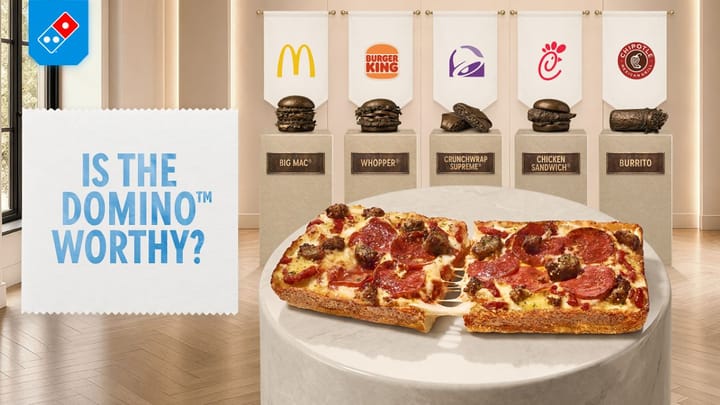
Domino's launched an audacious gamble this week, betting that its new individual pizza format can rival the cultural dominance of McDonald's Big Mac or Burger King's Whopper. The pizza chain initiated a giveaway campaign to drive trial of the new offering, essentially asking customers to sample what executives believe will become a signature menu item that defines the brand.
The strategy reveals a company confident enough to position its product directly alongside fast food's most iconic items. Rather than letting customers discover the pizza organically, Domino's removed friction by offering free product. This mirrors tactics competitors use when launching category-defining products. The Big Mac has anchored McDonald's menu for over 50 years. The Whopper, introduced in 1954, remains Burger King's centerpiece. Both achieved iconic status through decades of consistent presence, aggressive marketing, and cultural embedding.
Domino's faces a different challenge. Pizza lacks the singular dominance of the hamburger in American fast food culture. Competitors like Pizza Hut, Little Caesars, and regional chains all claim territory in the individual pizza space. What sets Domino's apart is scale. The chain operates nearly 6,500 U.S. locations, giving it distribution muscle to make a new menu item ubiquitous almost overnight.
The individual pizza format itself responds to changing consumer behavior. Americans increasingly favor single-serving portions, whether for solo diners, portion control, or convenience. Domino's existing offering has historically catered to families and groups ordering multiple pies. An individual pizza expands addressable occasions, particularly for weeknight meals and impulse orders. It also reduces decision fatigue for customers unsure how many slices they need.
The giveaway approach accelerates awareness and trial simultaneously. Free pizza removes purchase hesitation, the primary barrier preventing customers from breaking established ordering habits. Once people taste the product, repeat purchase depends on execution. Quality, consistency, pricing, and availability become the retention drivers. If the individual pizza disappoints, no giveaway resurrects it.
Domino's timing suggests confidence in product readiness. The company would not risk brand equity launching an inferior item across thousands of locations. The free pizza offer likely targets new customers and lapsed users rather than loyal repeat buyers, maximizing marketing efficiency.
The broader context matters. Restaurant chains increasingly treat menu innovation as competitive necessity. Digital ordering platforms, delivery services, and ghost kitchens have fractured customer loyalty. A signature item provides differentiation and gives consumers a reason to choose Domino's over DoorDash's entire catalog of delivery options. It becomes the mental anchor that drives app selection.
Success hinges on execution and messaging. Domino's must sustain promotional momentum beyond the initial giveaway. Advertising, influencer partnerships, and in-store visibility need coordination. The individual pizza needs a compelling name and visual identity to lodge in consumer memory. McDonald's never calls it "a beef patty sandwich." It's the Big Mac. Burger King owns "Have It Your Way." Domino's individual pizza needs equivalent ownership.
This move signals that Domino's views menu innovation as essential to competitive survival. The company operates in a mature market where growth comes from expanding eating occasions, not recruiting new pizza eaters. An iconic individual pizza accomplishes both, repositioning Domino's from family-focused pizza delivery to an all-day, all-occasion food destination.