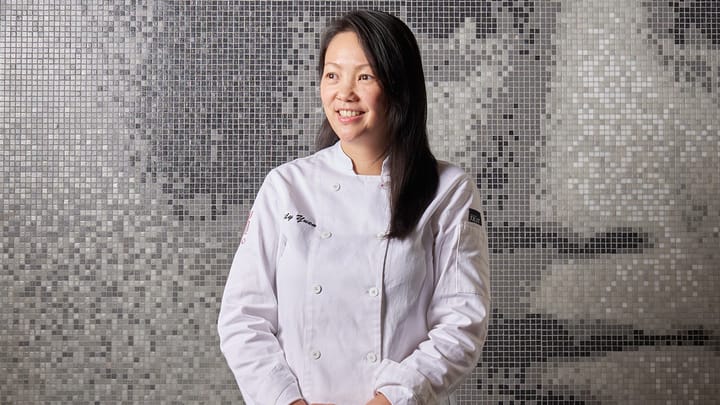
Emily Yuen, executive chef of Yingtao in New York City, bridges two culinary worlds with precision and purpose. Her restaurant represents a deliberate evolution of Chinese cooking, one where European technique meets family tradition. The wontons she crafts exemplify this philosophy: delicate parcels that honor her heritage while reflecting her formal training abroad.
Yuen's approach distinguishes itself in a crowded New York dining scene. Yingtao operates as a fine-dining establishment, not a casual dim sum parlor. This positioning matters. Her wonton fillings use premium proteins and carefully sourced ingredients. The wrapping technique emphasizes uniformity and elegance. Each fold carries intention. This is the language of haute cuisine applied to a working-class dumpling.
Her path to Yingtao reveals why her food tastes different. Growing up in a family with deep culinary roots, Yuen absorbed Chinese cooking fundamentals through observation and participation. But she pursued formal culinary education in Europe, absorbing classical French techniques, plating aesthetics, and the discipline of fine-dining service standards. That dual foundation separates her work from chefs trained exclusively in one tradition.
The wonton lesson with Bret Thorn, Nation's Restaurant News editor, captures something wider happening in Chinese-American fine dining. Young chefs like Yuen refuse the false choice between authenticity and innovation. They don't view European training as something to hide or downplay. Instead, they integrate it honestly. The result tastes fresher and more considered than either tradition alone.
Yingtao's menu reflects this integration throughout. Dishes likely feature classical Chinese flavor profiles, preparation methods honed over generations, and plating presentations taught in European culinary schools. The restaurant operates within fine-dining economics, meaning higher prices, smaller portions, and tablecloth service. This model works only if customers recognize and value the skill and sourcing involved.
For the broader restaurant industry, chefs like Yuen signal a shift. Chinese cuisine in America has long occupied two distinct lanes: casual, family-friendly neighborhood spots serving Americanized standards, or high-volume dim sum halls. Yingtao occupies a third space, one that demands diners engage with Chinese cooking as serious, refined cuisine worthy of premium pricing. This requires confident chefs willing to stand behind their training and heritage without apology.
The wonton itself becomes a teaching tool and a statement. In Yuen's hands, it demonstrates that tradition and technique coexist productively. A perfectly executed wonton skin, thin enough to see through, holding filling that balances textural contrast and flavor complexity, then plated with intentional restraint on a fine-dining plate. That progression tells Yuen's story better than any mission statement.
The restaurant's success depends partly on New York's demographic and cultural readiness to embrace this vision. The city contains both the Chinese culinary knowledge to appreciate nuance and the fine-dining culture to support premium pricing. Yuen capitalizes on both. She teaches not because wontons need explanation, but because the methodology reveals everything about her philosophy. Watching a chef fold wontons with precision, discussing ingredient selection and technique, signals respect for both her heritage and her training.