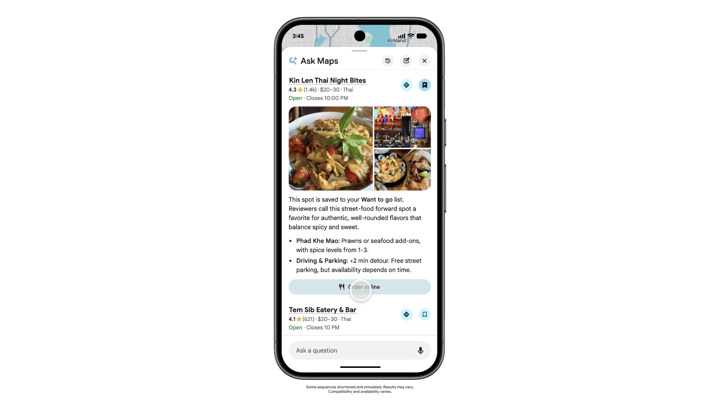
Google has embedded restaurant ordering directly into Google Maps, letting diners search for nearby restaurants and place orders without switching apps. The feature relies on Google's AI-powered Ask Maps tool, which understands natural language queries about food preferences, dietary restrictions, and location.
Users can ask questions like "Show me Italian restaurants near me that deliver" or "Find vegan options open now," and the system surfaces relevant results with ordering options. Once a restaurant appears in search results, customers tap to order through the Maps interface itself. The integration connects to existing restaurant ordering platforms and point-of-sale systems, meaning restaurants don't need separate infrastructure to participate.
This move reflects Google's broader strategy to monetize Maps as a commerce platform. The company has gradually transformed the navigation tool into a marketplace for local businesses. Restaurant ordering sits alongside Google's existing services like reservations through OpenTable, delivery options, and direct payment processing.
For restaurants, the friction of switching apps disappears. A diner scrolling Maps for dinner options can now complete a transaction in seconds rather than navigating to a third-party app. This could drive incremental orders, especially from casual browsers who weren't actively seeking out specific restaurants.
However, the feature adds complexity to Google's already crowded relationship with the restaurant industry. Delivery platforms like DoorDash and Uber Eats operate on commission models that have drawn criticism from restaurant operators. Google's approach doesn't clarify whether it charges commissions or simply acts as a finder service that directs users to existing ordering systems.
The timing matters. Restaurant tech adoption has plateaued after years of rapid growth in delivery and online ordering. Most diners use dedicated apps or restaurant websites directly. By inserting itself into the discovery moment, Google captures a crucial decision point before customers commit to a specific platform.
The Ask Maps integration represents a natural evolution for Google's search dominance into the local commerce space. Whether restaurants view