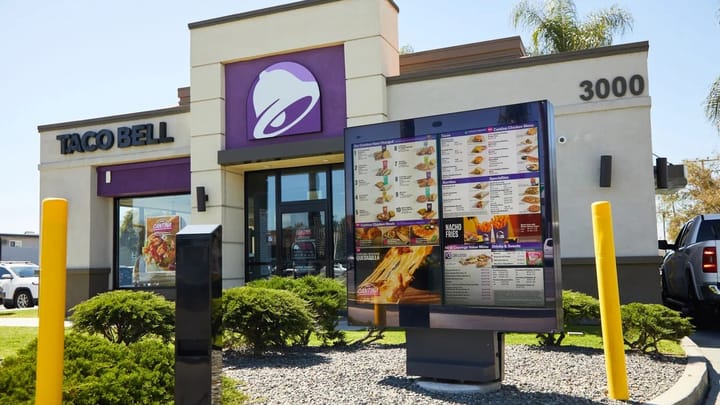
Taco Bell accelerates its rollout of drive-thru voice AI technology across nearly 900 restaurants in the United States. The fast-food chain deploys automated ordering systems to handle customer interactions at speaker boxes, reducing the workload on staff during peak hours.
The company cites improved employee retention as a key benefit. Workers at locations equipped with the technology report higher job satisfaction, likely because the systems eliminate repetitive order-taking tasks and allow employees to focus on food preparation and customer service roles with more variety. Taco Bell frames this as a workforce advantage in an industry plagued by chronic turnover.
The expansion represents a broader shift in quick-service restaurants toward automation. Voice AI systems capture orders with reasonable accuracy for straightforward menu items, though complex or customized requests still require human intervention. Taco Bell's system learns from interactions and improves over time, reducing errors in basic transactions.
Labor advocates have raised concerns about long-term employment effects, though Taco Bell's current data suggests the technology complements rather than replaces workers. The system handles volume during rushes, preventing bottlenecks that typically force managers to cut labor hours during slower periods. Early adopters report faster drive-thru times and reduced wait times for both customers and staff.
The nearly 900-restaurant footprint covers roughly 20 percent of Taco Bell's total U.S. locations. Success with this phase likely determines whether the chain commits to wider deployment. Competitors including McDonald's and Chipotle have tested similar voice ordering systems with mixed results, struggling with accent recognition and menu complexity. Taco Bell's more focused menu gives its AI a narrower problem to solve, potentially explaining smoother adoption rates.
The technology positions Taco Bell to address labor shortages while maintaining service speed, a persistent challenge for the industry. As restaurants compete for workers amid wage pressures, automation provides operational relief