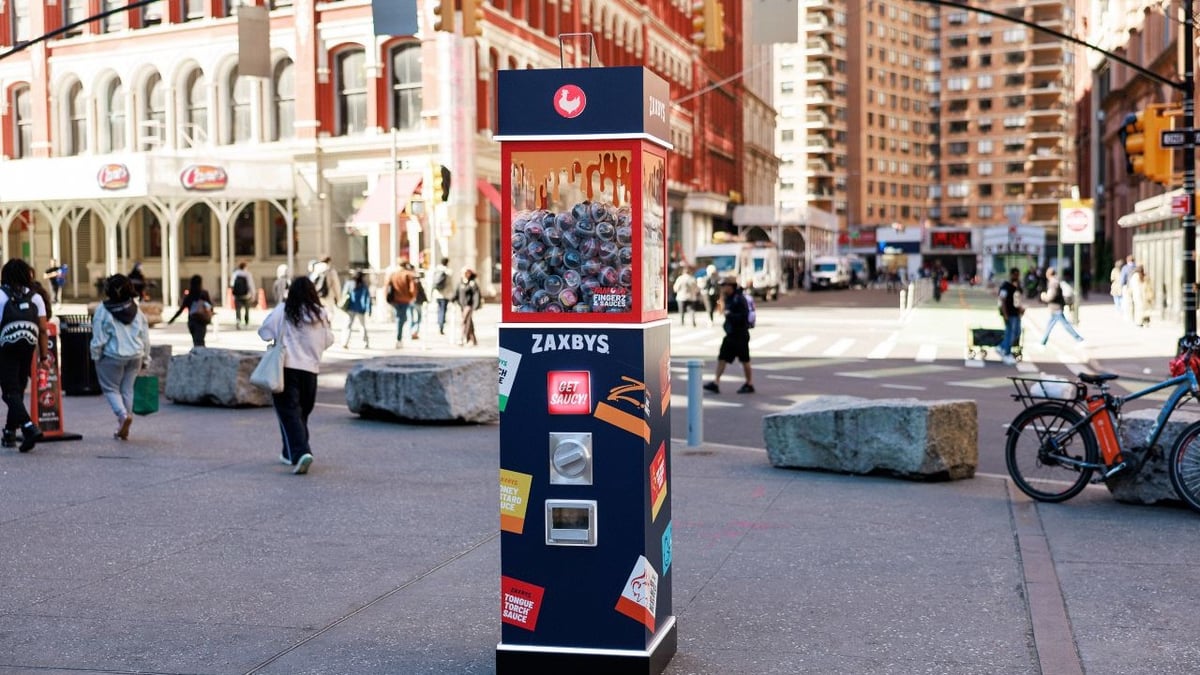
Zaxby's has escalated the competitive chicken wars with a bold marketing stunt that turns the fast-casual category into theater. The Georgia-based chain, which operates over 900 locations primarily across the Southeast, opened its first New York City restaurant this summer and immediately went after Raising Cane's by installing a sauce vending machine directly outside the competitor's flagship Astor Place location in Manhattan.
The move targets Raising Cane's most recognizable vulnerability. Cane's built its entire brand on obsessive simplicity, offering only chicken fingers, fries, coleslaw, and a single house sauce. That singular approach generated fanatical loyalty, but it also created an opening for rivals to exploit. Zaxby's, meanwhile, built its reputation on sauce variety and customization, offering customers multiple proprietary dipping options and flavor combinations.
The vending machine stunt serves multiple purposes. Operationally, it drives foot traffic by creating a novelty experience that people photograph and share on social media. Strategically, it positions Zaxby's as the anti-Cane's option for customers who want choice and variety rather than minimalist constraints. Culturally, it acknowledges that sauce matters to the chicken category in ways that transcend simple condiment preferences. Sauce signals personality, control, and experimentation.
Raising Cane's has maintained its formula with almost religious discipline since 1996. Founder Todd Graves has repeatedly defended the limited menu as central to operational efficiency and brand identity. Yet the company's explosive growth, including its national expansion and billion-dollar valuations from recent fundraising rounds, has made it an inevitable target. Zaxby's, founded in 1990 by Zach McLeroy and Tony Townley, operates a more traditional fast-casual model with expanded offerings including salads, sandwiches, and customizable combos alongside its finger platters.
New York City represents crucial competitive territory. Raising Cane's Astor Place location became a cultural phenomenon, with lines wrapping around the block during its opening weeks and ongoing crowds throughout the day. That density of foot traffic made it an irresistible canvas for Zaxby's marketing ambitions. The sauce vending machine turns a rival's strength into an advertising platform.
The stunt reflects broader shifts in fast-casual chicken positioning. While Cane's success proved that constraint could drive brand loyalty and operational excellence, it also demonstrated customer appetite for customization and flavor variety. Chick-fil-A, the category's largest player, succeeded partly through its own sauce portfolio and sandwich flexibility. Popeyes built muscle through bold flavor innovation and cultural relevance. Zaxby's has long occupied the middle ground: more diverse than Cane's, more established than emerging challengers like Culver's or Korean-influenced brands.
Whether the sauce vending machine converts curiosity into sustained customer acquisition remains uncertain. Stunt marketing generates headlines but doesn't guarantee repeat visits. Raising Cane's customers often display fierce brand loyalty that promotional gimmicks struggle to penetrate. Still, Zaxby's arrival in New York signals that the chain views national expansion as viable, and that direct competition with Cane's defines the next phase of fast-casual chicken growth.